4K IPTV Ireland: Broadband Speeds, HEVC Bitrates & Hardware Needed for True 50fps Streaming

Large-screen 4K Ultra HD televisions are now standard in Irish living rooms, yet many viewers who upgrade their screen are disappointed by what actually arrives over internet television. A channel labelled ‘4K’ can still look soft, pixelated during fast camera pans, or freeze every few minutes on a busy Saturday evening. In almost every case, the culprit is a mismatch somewhere along the streaming chain: an upscaled source feed, an underpowered streaming stick, a congested Wi-Fi router, or an overloaded server.
True Ultra HD streaming in Ireland works smoothly only when four technical layers align at once: a genuine 3840 × 2160 broadcast or cinema master, efficient HEVC (H.265) compression running on high-capacity servers, steady home broadband with low packet loss, and a living-room player capable of hardware-accelerated 50fps decoding. When even one of those four links is weak, the picture degrades regardless of how expensive your OLED or QLED television is.
This technical guide explains how to spot authentic 4K HDR streams versus upscaled HD feeds, exactly how much Irish broadband throughput you need per television, which hardware boxes handle HEVC without thermal throttling, and how to configure your home network for buffer-free Ultra HD playback.


Figure 1: True 4K HDR streaming reveals crisp fine textures and deep colour contrast on modern OLED and QLED televisions when paired with sufficient bitrate and HEVC decoding. [SEO Alt Text: Wall-mounted 4K HDR OLED television in a modern Irish living room displaying a razor-sharp coastal cliff landscape]
True 4K HDR vs Upscaled HD: How to Tell the Difference on Your TV
One of the most common frustrations in the Irish streaming market is mislabelled resolution. Budget IPTV resellers routinely take a compressed 720p or low-bitrate 1080p feed, re-encode it into a larger frame container, and stamp a ‘4K UHD’ tag next to the channel name. Because resolution alone does not determine visual clarity, a heavily compressed stream can look worse than a clean 1080p broadcast.
Fortunately, modern IPTV player apps such as TiviMate and IPTV Smarters Pro allow you to inspect live stream telemetry directly on screen. When evaluating any channel or on-demand movie, check three visual and technical indicators:
- Pixel Dimensions & Frame Rate: Authentic Ultra HD displays 3840 × 2160 pixels. For European and Irish live sports broadcasts, look for 50fps (or 60fps on North American feeds); for cinema films and drama series, 24fps or 25fps is the native theatrical standard.
- Bitrate Headroom: Clean HEVC 4K live channels typically sustain between 12 Mbps and 20 Mbps. If a channel labelled 4K runs below 6 Mbps, aggressive compression will smear grass textures on a football pitch and create blocky shadows in dark movie scenes.
- HDR Dynamic Range & 10-Bit Colour: Genuine HDR10 or HLG broadcasts trigger your television’s HDR picture badge automatically, expanding highlight brightness and shadow detail without washed-out greys.
Equally important is realism about source availability. Not every local Irish or UK broadcaster transmits in native 4K around the clock. The best engineering approach is adaptive delivery—providing native 4K HDR where the broadcaster or studio releases it, paired with razor-sharp 50fps Full HD (1080p) on standard channels so every feed looks crisp rather than artificially stretched.
Minimum Irish Broadband Speeds for 4K, Full HD & Multi-Room Viewing
Ireland’s broadband network varies widely between urban FTTH (Fibre to the Home) rollouts in Dublin, Cork, Galway, and Limerick and rural VDSL copper, fixed wireless, or 4G/5G connections. While headline download speeds on Eir, Virgin Media, Vodafone, and Sky Fibre often exceed 500 Mbps, raw speed tests rarely tell the whole story. Sustained throughput, ping stability, and jitter determine whether a 4K stream plays uninterrupted for two hours.
| Stream Quality Tier | Min Speed (1 TV) | Recommended (2–3 TVs) | Typical Irish Broadband Fit |
| Standard HD (720p) | 5 Mbps | 15–20 Mbps | Rural copper broadband, fixed wireless, and basic 4G connections |
| Full HD (1080p · 50fps) | 10 Mbps | 25–35 Mbps | All VDSL copper, strong 4G/5G, and entry-level fibre plans |
| True 4K UHD (HEVC / HDR) | 25 Mbps | 60–100+ Mbps | Urban/rural FTTH fibre, Virgin Media coax, and strong 5G routers |
| 4K Multi-Room + Gaming | 50 Mbps+ | 150–500 Mbps | Busy Irish family homes streaming 4K while downloading or gaming |
Always leave at least 30% to 40% bandwidth headroom above the raw stream requirement. When a smartphone backs up photos to iCloud, a PlayStation downloads a patch, or another household member starts a video call, a broadband line running right on the edge of 25 Mbps will immediately dip below the 4K buffer threshold. Viewers researching reliable 4K IPTV Ireland options should confirm that adaptive 4K, FHD, and HD streams are included on every plan so secondary rooms on weaker Wi-Fi can step down seamlessly to Full HD without interrupting the main living-room television.
Figure 2: A wired Ethernet link from your fibre wall socket and router—or an unobstructed 5 GHz Wi-Fi signal—prevents the packet loss that causes 4K streams to stall. [SEO Alt Text: Minimalist technical illustration of a fibre broadband socket wired to a modern router delivering smooth green signals to a 4K television]
See also: Guide to Managing Digital Business Payments With Cryptocurrency
Best 4K Hardware in Ireland: Firestick 4K Max, Android Boxes & Smart TVs
Decoding a 10-bit HEVC 4K stream at 50 frames per second puts far heavier demands on a media processor than playing a standard YouTube clip. Many Irish households blame their broadband or streaming provider when the true bottleneck is an underpowered television chipset or a first-generation streaming stick overheating behind a wall-mounted screen.
| Device Category | 4K HEVC & 50fps Performance | Networking & Storage | Best Fit for Irish Homes |
| Fire TV Stick 4K Max / Cube | Excellent hardware HEVC/HDR decoding and smooth 50fps output | Wi-Fi 6 / 6E; optional Ethernet adapter; 16 GB storage | Best overall value and easiest 5-minute setup for most Irish TVs |
| Nvidia Shield / Formuler Box | Flagship decoding, AI upscaling, zero frame drops on high bitrates | Built-in Gigabit Ethernet port + expandable storage | Enthusiasts who want instant EPG zapping and multi-view sports |
| Modern Samsung / LG Smart TV | Good native 4K playback on 2023+ models; slower on older sets | 100 Mbps Ethernet or dual-band Wi-Fi; limited app RAM | Clean single-remote living rooms with strong router proximity |
| Apple TV 4K | Ultra-fast A-series chip handles 4K HDR effortlessly | Gigabit Ethernet (top model) + Wi-Fi 6 | Apple households using GSE Smart IPTV or modern tvOS players |
Three Hardware Mistakes That Ruin 4K Playback
Even with capable hardware, three small physical setup mistakes regularly sabotage Ultra HD smoothness:
- Powering a Firestick from the TV’s USB Port: Most television USB ports supply insufficient amperage for sustained 4K HEVC decoding, causing random reboots and micro-stutters. Always plug your streaming stick into the wall power adapter.
- Using Outdated HDMI Cables or Non-4K Ports: On older 4K televisions, only HDMI Port 1 or Port 2 may support full HDMI 2.0/2.1 bandwidth at 50/60Hz with HDR. Verify your port label and enable ‘HDMI UHD Color’ or ‘Enhanced Signal’ in TV settings.
- Running Software Decoding Instead of Hardware Decoding: Inside players like TiviMate or IPTV Smarters Pro, ensure ‘Hardware Decoder’ is selected for video so your device’s dedicated GPU handles HEVC rather than overloading the main CPU.
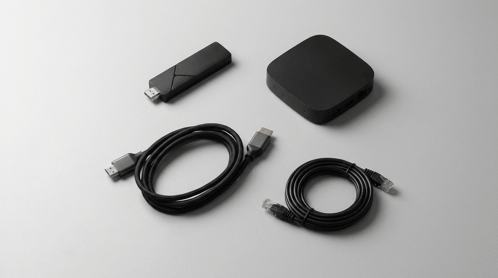
Figure 3: Dedicated streaming hardware paired with an HDMI 2.0/2.1 cable and wired Ethernet consistently outperforms aging built-in Smart TV processors on high-bitrate 4K feeds. [SEO Alt Text: Minimalist flat-lay photograph of a 4K streaming stick, compact Android TV box, braided HDMI cable, and coiled Ethernet cable]
Why HEVC (H.265) and 10 Gbit/s Anti-Freeze Servers Prevent Frame Drops
Behind the scenes, video compression efficiency makes the difference between effortless 4K streaming and constant buffering circles. Older H.264 (AVC) streams require roughly double the bandwidth of modern HEVC (H.265) streams to achieve the same visual sharpness. By adopting HEVC encoding alongside adaptive bitrate ladders, a well-engineered server delivers crisp 4K detail over a standard 25 Mbps Irish home line while consuming dramatically less wireless airtime.
Server-side capacity is the other half of the equation. Delivering simultaneous 4K streams to thousands of Irish households during a Sunday afternoon Gaelic football final or a Saturday Premier League double-header requires high-throughput 10 Gbit/s server infrastructure with automated load balancing and redundant failover paths. When an upstream route experiences congestion, Anti-Freeze architecture shifts traffic to a clean backup node in milliseconds—keeping the television buffer full so viewers never see a freeze frame.
Encrypted built-in VPN routing complements this infrastructure directly. Because some Irish internet providers apply automated evening traffic shaping to high-bandwidth streaming ports, encrypting the stream prevents artificial peak-hour throttling without forcing viewers to run heavy third-party VPN software that can cut raw throughput in half on slower streaming sticks.
4K On-Demand Films & Box Sets: Audio, Subtitles & Weekly Updates
While live sport gets most of the attention in Ireland, on-demand cinema and television box sets account for more than half of weekly viewing time in many family homes. Modern 4K VOD libraries bring together recent theatrical releases, classic films, Irish and British drama, kids’ favourites, and complete multi-season box sets inside the exact same app interface as live television—eliminating the need to juggle four separate monthly streaming subscriptions.
When testing an on-demand 4K catalogue, pay close attention to three quality-of-life details that separate curated libraries from neglected ones:
- Instant Seeking Without Re-Buffering: Jump 40 minutes ahead inside a 4K HDR film. Well-hosted VOD servers resume playback within two seconds rather than stalling.
- Clean Multi-Track Audio & Synced Subtitles: Verify that 5.1 surround sound tracks decode cleanly on your soundbar or AV receiver and that English subtitles stay tightly synchronized across entire box-set seasons.
- Consistent Weekly Catalogue Refreshes: A large on-demand library only stays valuable when new cinema releases and newly aired drama episodes are added reliably every week rather than sitting stale for months.
For households looking to replace multiple paid movie apps with one unified home-cinema experience, browsing dedicated IPTV movies and series in 4K catalogues during a 24-hour test lets you confirm HDR picture depth, audio clarity, and subtitle timing on your own television before choosing a monthly or yearly plan.
Figure 4: A well-maintained 4K HDR on-demand library turns an Irish living room into a complete home cinema with instant playback, box sets, and synchronized subtitles. [SEO Alt Text: Cozy Irish living room at night with a large 4K Smart TV playing a vivid cinematic mountain and ocean film in HDR]
4K IPTV Ireland FAQ
1. Is 25 Mbps broadband enough for 4K IPTV in Ireland?
Yes, 25 Mbps of stable, low-jitter download speed is sufficient for one television streaming HEVC-encoded 4K HDR. If two or three screens in your home stream simultaneously—or if other family members download large files—aim for 60 Mbps to 100 Mbps or higher.
2. Why does a 4K channel sometimes buffer even on 500 Mbps Irish fibre?
High headline fibre speeds do not protect against weak 2.4 GHz Wi-Fi through thick walls, an overheating streaming stick powered by a TV USB port, evening ISP traffic shaping, or an overloaded provider server. Switching to wired Ethernet or 5 GHz Wi-Fi and testing a provider with 10 Gbit/s Anti-Freeze servers and a built-in VPN resolves the vast majority of buffering issues.
3. Which streaming device handles 4K HEVC 50fps best in Ireland?
For most Irish households, the Amazon Fire TV Stick 4K Max offers the strongest balance of price, Wi-Fi 6E speed, and smooth hardware HEVC decoding. For enthusiasts who want Gigabit Ethernet and maximum responsiveness, the Nvidia Shield TV Pro, Fire TV Cube, or Apple TV 4K are top-tier upgrades.
4. What is the difference between 4K 25fps and 4K 50fps for live sport?
50fps displays twice as many frames every second as 25fps, matching the native Irish and UK broadcast standard. On fast-moving sports such as hurling, Gaelic football, rugby, and Premier League football, 50fps eliminates motion blur and keeps rapid ball movement sharp.
5. Can I test true 4K HDR quality on my own TV before subscribing?
Yes. Always request a 24-hour no-card free trial and test both a live 50fps sports channel at 8:00 PM and a 4K HDR on-demand film on your primary television so you can verify real-world picture sharpness and stability on your own broadband line.