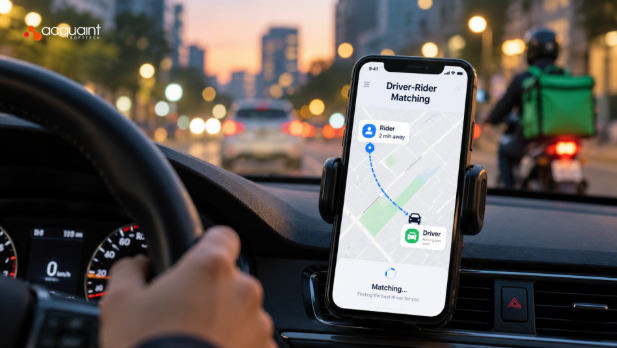
As the Product Engineering Lead at Acquaint Softtech, a Mobile App Development partner, the question every ride-hailing founder eventually asks is this: our drivers are online and our riders are requesting, so why does the wrong car keep getting the trip?
The answer is the driver-rider matching algorithm. It is the logic that scans every nearby driver, scores them in real time, and assigns the single best one in under three seconds, turning a map full of moving cars into one confident dispatch. This guide covers how to build it, from the scoring and geospatial model to the cost behind them.
A matching engine that picks the wrong driver is worse than a slow one, because riders cancel and drivers lose trust. The approach here draws on real on-demand products Acquaint Softtech has delivered as an Official Laravel Partner, with 1,300+ projects, 70+ in-house engineers, and clients across the USA, UK, Europe, and Australia who get a dedicated team within 48 hours of a brief.


What a driver-rider matching algorithm is
A driver-rider matching algorithm is the decision engine inside a ride-hailing app that connects one ride request to the best available driver in real time. It answers the question a raw list of online drivers never can: not who is nearby, but who should get this trip.
See also: How Affordable Supplements Can Help You Achieve a Healthier Lifestyle
Who relies on it, and when
Three groups depend on it: riders who want a fast pickup, drivers who want fair and steady trips, and operations teams who want high fill rates. Each feels the same algorithm differently, so design it for all three from the start rather than tuning only for pickup speed. Acquaint Softtech designs these role views in from day one.
Why the 3-second target matters
The three-second target matters because rider patience is short and driver positions go stale fast. Past that window, cancellations climb and the driver you picked may already have moved out of range.
Speed is a retention metric
Every extra second of matching raises cancellation risk and wastes driver attention on offers they can no longer fulfil. Three seconds is the practical ceiling: fast enough to feel instant, long enough to score candidates properly rather than grabbing the nearest dot.
The five stages of a match
A match runs in five stages, each with its own slice of the three-second budget. Naming them separately is what lets you find the slow one later.
From request to locked ride
1. Capture the request: pickup, destination, and rider preferences enter the system.
2. Filter candidates: a geofence narrows thousands of drivers to a local shortlist.
3. Score candidates: each driver earns a score from ETA, distance, heading, rating, and acceptance chance.
4. Dispatch: the top driver gets the offer; if declined in seconds, the next best is offered.
5. Confirm and lock: the ride is confirmed, the driver is marked busy, and both apps update.
Scoring: how the best driver is chosen
The best driver is chosen by a weighted score, not by raw distance. Each candidate earns points for estimated time of arrival, distance, heading, rating, and the chance they accept, and the highest total wins the offer.
Beyond distance
Straight-line distance ignores roads and traffic, so an ETA-based score often picks a slightly farther driver who arrives sooner. Predicting which driver will actually accept is where AI development services add real value, because a model turns a slow retry loop into a confident first-try match.
The geospatial data model behind it
The instant feel comes from the data model, not a clever formula. Every driver location and ride event is captured as a timestamped record, and a geospatial index, a structure that finds nearby points quickly, narrows thousands of drivers to a shortlist before any scoring runs.
Index first, score second
Filter by a geofence, then score only the handful of drivers inside it, so the engine answers in milliseconds instead of scanning a whole city. Keeping locations fresh is a pipeline problem, and teams that hire data engineers get accurate, low-latency location streams instead of stale positions that cause failed matches.
Batch vs greedy matching at surge
Greedy matching assigns each request the moment it arrives, which is simple and fast in normal demand. At surge, batch matching pools requests over a short window and solves them together, which raises overall fill rates and fairness.
When to pool requests
| Approach | How it works | Best for |
| Greedy | Matches each request the moment it arrives | Normal demand, low density |
| Batch | Pools requests over a few seconds and solves as a group | Surge and high density |
| Hybrid | Greedy by default, switches to batch under load | Most production apps |
Most production apps Acquaint Softtech builds run greedy by default and switch to batch when demand spikes.
What it costs to build
The cost of a matching engine depends on how smart it needs to be. A solid ETA-based matcher is far cheaper than a predictive, surge-aware system with machine learning.
| Scope | What you get | Typical range (USD) |
| MVP matcher | ETA and distance scoring, greedy dispatch | $8,000 to $20,000 |
| Advanced engine | Batch matching, acceptance prediction, surge logic | $20,000 to $50,000 |
Where the savings are
Start with ETA-based greedy matching, the version that covers most trips, then add batch and prediction once your event pipeline is stable. Acquaint Softtech staggers the build this way, running at up to forty percent cost savings versus Western agencies, with blended rates of roughly twenty-five to forty-nine US dollars per hour.
Proof: real-time dispatch we shipped
The same real-time dispatch pattern powers more than ride-hailing. For 1st Choice Pest Solutions, a US pest control company, Acquaint Softtech built a mobile app that coordinates field technicians the way a matching engine coordinates drivers. The account below is drawn from the client’s 5.0 out of 5 Clutch review.
| Challenge | Solution | Result |
| Technicians ran on printed schedules and calls to the office | Mobile app with live schedules, routing, and job status | Instant office visibility into every technician and job |
| Last-minute service requests were hard to assign fast | Real-time coordination between the office and the field | Smoother dispatch when urgent jobs came in |
| Older internal tools slowed the team | Augmented Laravel and mobile team with backend scheduling | Modernized tools and faster feature delivery |
The build followed the principle this guide describes: live coordination beats manual dispatch. Owner and CEO Mike Ness credited the app with “much smoother coordination between the dispatch team and technicians”, the field-service version of assigning the right driver fast. Whether the unit is a driver or a technician, the lesson Acquaint Softtech carries into every build is the same: trustworthy dispatch runs on live data, not phone calls.
FAQs
What is a driver-rider matching algorithm?
It is the logic inside a ride-hailing app that assigns one ride request to the best available driver in real time. It scores nearby drivers on ETA, distance, heading, rating, and acceptance chance, then dispatches the highest-scoring driver within a strict time budget.
How does matching happen in under 3 seconds?
By narrowing thousands of drivers to a small shortlist before scoring. A geospatial index, in-memory data, and parallel scoring keep the heavy work small, so the engine answers in milliseconds and confirms the ride inside the three-second window.
Is the nearest driver always the best match?
No. Straight-line distance ignores roads, traffic, and driver heading. An ETA-based score often picks a slightly farther driver who reaches the rider sooner, which improves pickup times and lowers cancellations.
What database supports driver-rider matching?
Geospatial stores like Redis Geo or PostGIS, often paired with H3 or S2 grid cells, handle fast proximity lookups. A streaming layer keeps driver locations fresh so the system never scores stale positions.
What is batch matching?
Batch matching pools ride requests over a few seconds and solves them together instead of one at a time. It raises fill rates and fairness during surge, when greedy one-by-one matching would leave some riders unserved.
Does matching need machine learning?
Not to start. ETA-based scoring works well for early apps. Machine learning helps later by predicting driver acceptance and rider demand, which raises first-try match rates on busy, mature platforms.