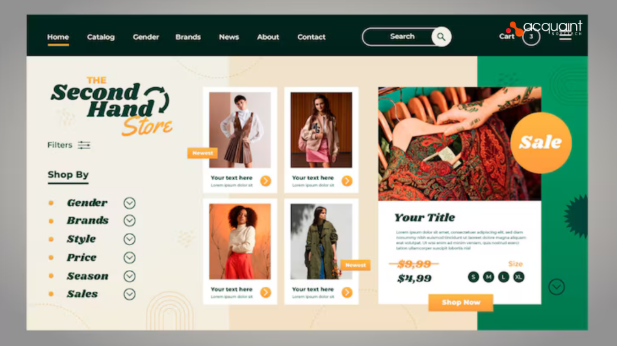
As the Frontend and Conversion Lead at Acquaint Softtech, I see D2C brands make the same trade-off wrongly: they treat a beautiful storefront and a high-converting one as opposites. They are not. The best D2C branded storefront design conversion comes from a store that carries the brand’s feeling and removes every gram of friction between discovery and checkout.
This guide covers the design elements, the engineering behind them, and how to build the whole thing. The build itself is a core piece of any custom software product development effort.
The opportunity is large. D2C has become the default way brands build, because cutting out the middleman gives higher margins, direct customer data, and loyalty that traditional retail cannot match. But those gains only land if the storefront converts the traffic you pay to acquire. Conversion benchmarks and abandonment data are tracked by the Baymard Institute.


This is the companion to the Complete Guide to E-Commerce Software Development. It draws on real commerce platforms Acquaint Softtech has built as an Official Laravel Partner, with 1,300+ projects, 70+ in-house engineers, and clients across the USA, UK, Europe, Australia, and New Zealand who deploy dedicated teams within 48 hours of a brief.
What a branded D2C storefront is
A branded D2C storefront is a direct-to-consumer online store that a brand owns end-to-end, rather than renting space on a marketplace. It carries the brand’s identity in its look, voice, and experience, and it captures the customer relationship and data directly. That ownership is the whole point of the direct-to-consumer model.
Design is a business asset, not decoration
In D2C, the storefront is the brand’s primary channel, so its design is a revenue lever, not a coat of paint. Building it well combines brand craft with real D2C tech engineering, and it belongs in the earliest product engineering services conversations rather than being bolted on at the end.
See also: How Affordable Supplements Can Help You Achieve a Healthier Lifestyle
Why brand and conversion are not opposites
Brand and conversion are often framed as a tug-of-war between designers who want beauty and growth teams who want tested buttons, but the highest-performing D2C brands refuse the choice. Conversion-first design means the store feels unmistakably like the brand while making it effortless to act at every step. Beauty that slows the shopper down is not good branding; it is friction in a nice outfit.
The resolution is simple to state and hard to execute: keep the brand’s emotional identity, then remove every unnecessary obstacle between the shopper and the buy button. Differentiation and trust are what lower acquisition cost, and a frictionless path is what turns that trust into orders. The two goals pull in the same direction when the build is done right.
The design elements that lift conversion
A handful of design elements do most of the conversion work, and each is a buildable module rather than a vague principle. The table below lists the levers that matter most and what each one does for the shopper.
| Element | What it does | How to build it |
| Fast loading | Removes the wait that loses mobile buyers | Optimize images and code, lazy-load |
| Clear visual hierarchy | Guides the eye to the action | High-contrast CTAs, prominent placement |
| Simplified navigation | Helps shoppers find categories in seconds | Reduce menu clutter, clear labels |
| Streamlined checkout | Cuts drop-off at the final step | Minimal fields, express payment |
| Trust signals | Reassures a first-time buyer | Reviews, guarantees, secure badges |
Treat each of these as a component in your D2C platform modules, not a one-off tweak. Built as reusable modules, they can be measured, improved, and carried across the whole store, which is the difference between a lucky redesign and a repeatable system.
Performance: the invisible conversion lever
Speed is the conversion lever nobody sees, but everybody feels. A storefront that loads instantly on a mid-range phone converts materially better than a beautiful one that stalls, because shoppers abandon slow pages before the design ever gets a chance to work. Performance is not a technical nicety; it is a direct revenue input.
Optimizing images, trimming code, lazy-loading below-the-fold content, and serving from a CDN are the unglamorous work that makes brand design actually pay off. This is where D2C brand technology decisions matter most, and it is a job for engineers who treat Core Web Vitals as a business metric, which is why many brands hire MERN stack developers who can build fast and measure it.
Mobile-first design that converts
Most D2C traffic is mobile, so the phone is the primary design surface, not an afterthought. Mobile-first means buttons sized for thumbs, text that scales cleanly, image galleries that swipe smoothly, and a checkout that fits a small screen without pinching or scrolling into oblivion. Design for the phone first, then scale up to desktop.
- Thumb-friendly targets: tap areas large enough to hit without zooming.
- Readable scaling: text and images that adapt to any screen size.
- Smooth galleries: product media that swipes fast and loads progressively.
Trust signals and social proof
Trust signals close the gap between an interested shopper and one who buys, especially for a brand they do not yet know. Verified reviews, ratings, guarantees, secure-payment badges, and real customer photos answer the silent doubts a product page leaves open. A first-time buyer is asking Is this legit, and trust signals answer it.
Placed on product pages where the decision happens, social proof and reassurance lift add-to-cart and purchase rates without changing the product at all. Wiring reviews and user content into the storefront cleanly is part of good D2C branded implementation, and it is commonly delivered through software development outsourcing when an in-house team is at capacity.
Behavior tracking and analytics
You cannot improve what you cannot see, so behavior tracking is the engine behind every conversion gain. Analytics tools show where visitors drop off before buying, which pages lose them, and which paths the best customers take, turning guesswork into decisions. Without it, a redesign is a bet; with it, it is an experiment.
Wiring in event tracking, funnels, and session insight from launch means the store teaches you how to improve it. Reading those signals and acting on them is ongoing work, and technical direction across the storefront is available through a virtual CTO when the team wants a senior second view on the data.
Themed store vs custom or headless build
The build choice shapes how far the brand can go. A themed store on a platform like Shopify is fast and cheap to launch but limited in customization and often heavier than it needs to be. A custom or headless build gives full control of brand and performance, at the cost of more engineering, and it is the path for brands whose ambitions outgrow a template.
| Approach | Best for | Trade-off |
| Themed store | Fast launch, small brands | Limited control, template feel |
| Customized theme | Mid-size brands wanting more | Still bound by the platform |
| Custom or headless | Ambitious, performance-led brands | More engineering and cost |
Most growing brands start themed and move to a custom or headless build modern e-commerce approach, as their traffic and differentiation demands rise. The Acquaint Softtech team recommends the path that fits the brand’s stage rather than pushing a rebuild nobody needs yet.
How to build a branded D2C storefront
Knowing how to build D2C storefront experiences that convert follows a clear sequence. The steps below keep the D2C platform module design disciplined, whether you customize a theme or build custom from the ground up.
- Define the brand system. Lock the colors, type, voice, and imagery that every page will use.
- Design the key pages. Build home, collection, product, and checkout around one clear action each.
- Engineer for speed. Optimize images and code and serve from a CDN so pages paint fast on mobile.
- Wire in trust and tracking. Add reviews, badges, and analytics events from the start, not later.
- Test and iterate. Use behavior data to fix the biggest drop-off, then repeat.
Handled in this order, the storefront stays modular and measurable, so each improvement compounds instead of resetting the last one.
What a D2C storefront costs
The D2C development cost in India depends on whether you customize a theme or build custom, how many modules you need, and whether performance and analytics are engineered in. The figures below reflect typical ranges to design and build the storefront. A custom direct-to-consumer India-based build sits well below Western agency pricing for equivalent seniority.
| Scope | What it includes | Typical range (USD) |
| Themed launch | Brand-styled theme, core pages, basic setup | $3,000 to $8,000 |
| Customized theme | Above plus custom modules and speed work | $8,000 to $20,000 |
| Custom storefront | Bespoke design, performance, analytics | $20,000 to $50,000 |
| Headless platform | Custom frontend, API-first, multi-channel | $50,000 and up |
Where the real savings are
The template is cheap; the design, speed engineering, and analytics are where value is made. To build a D2C brand platform, working with an India-based team lands at up to 40% cost savings versus Western agencies, with blended rates of roughly $20 to $45 per hour.
When you hire developers for D2C work, judge them on performance and conversion thinking, not on how pretty a mockup looks. A full domain-ready pod is delivered as a dedicated development team.
How to scale a D2C brand
Scaling a D2C brand means growing revenue without the storefront or operations breaking under the load. That takes a fast, modular platform that can add channels and features, a retention strategy that lifts repeat purchase, and analytics that keep pointing at the next bottleneck. Growth exposes whatever the storefront did badly, so the foundation has to be sound first.
Brands that scale well treat the storefront as a product that keeps improving, not a project that ends at launch. Ongoing performance and feature work after launch is handled through support and maintenance, which keeps the store fast and current as traffic grows.
How to hire for a D2C build
The right hire for a D2C build understands three things: brand-faithful frontend craft, performance engineering, and conversion thinking backed by analytics. A generic developer can assemble a theme, but a high-converting branded store is a craft, and it decides whether the brand’s traffic turns into revenue or bounces.
Look for engineers who have shipped and measured real D2C stores, because conversion lessons come from live traffic, not tutorials. Scoping the work correctly first is the job of a short discovery workshop, which turns brand goals into a concrete build plan.
Proof: the conversion levers that moved the needle
The clearest way to show a storefront rebuild is to score each lever that was pulled. Acquaint Softtech redesigned and rebuilt the branded storefront for an apparel D2C brand on Lampoo’s platform, keeping the brand’s identity while removing friction.
This account is drawn from the client’s verified 5.0 out of 5 Clutch review, and the scorecard below rates each lever from weak to strong before and after.
| Conversion lever | Before | After |
| Mobile load speed | Weak, slow first paint | Strong, near-instant |
| Visual hierarchy and CTAs | Fair, buttons blended in | Strong, high-contrast actions |
| Navigation clarity | Weak, cluttered menus | Strong, category in seconds |
| Checkout friction | Fair, long form | Strong, minimal fields, express pay |
| Trust signals | Weak, hidden reviews | Strong, proof on product pages |
| Behavior tracking | None | Strong, full funnel instrumented |
Each lever moved from weak or fair to strong, and the storefront kept the brand’s look while shedding the friction that had been costing sales. Order processing ran on a Laravel asynchronous queue so the store stayed fast under load.
The lesson is that a brand does not have to choose between beautiful and high-converting; it has to engineer both, lever by lever.
Questions buyers ask
Is Amazon a D2C or B2C?
Amazon is primarily a B2C marketplace and retailer: it sells to consumers and hosts third-party sellers rather than being a single brand selling its own products directly. Some of Amazon’s own private-label lines are D2C in nature, but as a platform, Amazon is a marketplace, which is exactly the middleman that D2C brands build their own storefronts to bypass.
What do D2C brands mean?
D2C, or direct-to-consumer, means a brand sells its own products straight to shoppers through its own channels rather than through retailers or marketplaces. Cutting out the middleman gives the brand higher margins, direct access to customer data, and a closer relationship with buyers. The branded storefront is the D2C brand’s primary channel and its main growth engine.
How do you scale a D2C brand?
Scale a D2C brand on three fronts: a fast, modular storefront that can add channels and features without breaking, a retention strategy that lifts repeat purchase, and analytics that keep surfacing the next bottleneck. Growth exposes weak foundations, so performance and clean architecture must come first. Treat the storefront as a product that keeps improving, not a one-time launch.
How do you build a D2C brand?
Build a D2C brand by defining a clear identity, then expressing it in an owned storefront that is fast, on-brand, and frictionless from discovery to checkout. Add trust signals and behavior tracking from the start, choose a themed or custom build to match your stage, and iterate using real conversion data. The brand is the differentiation; the storefront is where it earns money.
How does this help D2C brands?
A well-engineered branded storefront turns the traffic a D2C brand pays to acquire into completed orders. It keeps the brand’s identity while removing friction, loads fast on mobile, guides shoppers to the action, and builds trust, all of which lift conversion. Because the brand owns the channel, it also captures the customer data needed to keep improving.
How do you implement this for D2C?
Implement it by locking the brand system first, designing home, collection, product, and checkout around one clear action each, and engineering for speed with image and code optimization and a CDN. Wire in reviews, badges, and analytics events from launch, then use behavior data to fix the biggest drop-off and repeat. Build the elements as reusable modules, not one-off tweaks.
What are the best practices for a D2C storefront?
Keep the brand’s identity while removing friction: fast mobile loading, clear visual hierarchy with high-contrast CTAs, simplified navigation, and a streamlined checkout with express pay. Show trust signals on product pages, design mobile-first, and instrument behavior tracking so every change is data-driven. Build for performance, because a slow beautiful store converts worse than a fast plain one.
What is the cost for D2C brands?
A brand-styled themed launch typically runs about $3,000 to $8,000, a customized theme $8,000 to $20,000, and a custom storefront with performance and analytics $20,000 to $50,000, with headless platforms above that. An India-based team delivers the same work at up to 40% below Western agency rates, with blended rates near $20 to $45 per hour.