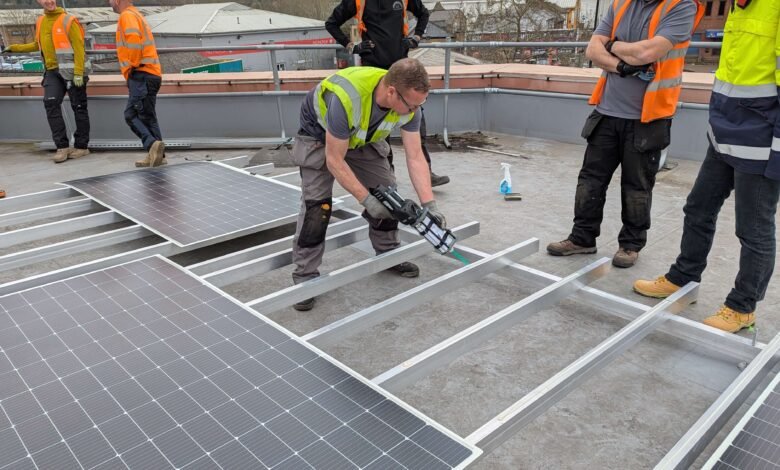
Solar module manufacturing depends on materials that can maintain reliable physical and processing characteristics throughout assembly. Adhesive and sealant systems used in photovoltaic applications must be formulated carefully because viscosity, dispensing behavior, adhesion, curing, and environmental resistance can all influence manufacturing quality.
Fine inorganic materials are sometimes incorporated into adhesive formulations to modify specific properties. Silica is one material that can be evaluated for this purpose, but its effectiveness depends on particle characteristics, surface chemistry, dispersion, and compatibility with the adhesive matrix.
Read Also: Setting Up Business Energy for New Premises: How to Avoid Overpaying From Day One
The Role of Functional Fillers


Fillers can serve several purposes in adhesive formulations.
Depending on their characteristics, they may influence viscosity, rheology, reinforcement, dimensional stability, or processing behavior.
The selection of a filler should therefore begin with the requirements of the adhesive rather than simply choosing a material based on its chemical composition.
In photovoltaic applications, formulation consistency is particularly important because adhesive systems may need to be dispensed accurately across repeated production cycles.
Why Rheology Matters
Rheology describes how a material flows and deforms under applied forces.
For adhesives used in automated assembly, rheological behavior can influence pumping, dispensing, spreading, and positioning.
A formulation that is too fluid may spread beyond the desired area, while a material that is too viscous may be difficult to dispense.
Fine silica can influence these characteristics depending on concentration, surface properties, and interaction with the adhesive system.
Hydrophilic and Hydrophobic Characteristics
Silica materials can have different surface characteristics.
Hydrophilic surfaces generally have greater affinity for water, while hydrophobic surfaces are modified to reduce interaction with water.
These differences can influence dispersion and interaction with the surrounding adhesive.
The appropriate type depends on the chemistry of the formulation and the environmental conditions in which the adhesive will be used.
Dispersion Is Essential
Fine silica particles can form agglomerates if processing is not properly controlled.
Agglomeration may create inconsistencies in viscosity, appearance, or mechanical behavior.
Manufacturers should evaluate mixing equipment, addition sequence, shear conditions, and processing time.
A controlled dispersion procedure should be developed during formulation development and maintained during production.
Adhesive Processing
Photovoltaic adhesive systems may be processed using automated dispensing equipment.
For reliable manufacturing, the adhesive should have predictable flow characteristics.
Engineers can evaluate parameters such as:
- Viscosity
- Thixotropic behavior
- Dispensing consistency
- Cure time
- Adhesion
- Storage stability
- Mechanical properties
The appropriate test program depends on the adhesive chemistry and application.
Moisture Considerations
Moisture can interact with certain adhesive systems and raw materials.
The effect depends on the chemistry of the formulation and the specific silica grade.
Manufacturers should therefore evaluate moisture sensitivity during storage, mixing, and curing.
Packaging and handling procedures should follow supplier recommendations.
Mechanical Performance
Fillers can influence the mechanical characteristics of an adhesive.
The actual effect depends on particle loading, dispersion quality, binder chemistry, and curing conditions.
A higher filler concentration does not automatically provide better performance.
Formulation developers should identify an appropriate balance through controlled laboratory testing.
Environmental Testing
Photovoltaic components can be exposed to changing temperatures, humidity, sunlight, and other environmental conditions.
Adhesive formulations should therefore be evaluated under conditions that represent their intended use.
Testing can help identify changes in adhesion, flexibility, appearance, or other relevant properties.
Environmental testing should be interpreted according to the requirements of the specific product and application.
Selecting a Suitable Silica Grade
Manufacturers evaluating fumed silica photovoltaic adhesive should consider the relationship between silica properties and the complete adhesive formulation.
Important factors may include surface characteristics, specific surface area, dispersion behavior, moisture interaction, and compatibility.
Quality Control
Consistent raw materials support consistent manufacturing.
Incoming inspection can include verification of material identity, packaging condition, relevant specifications, and batch documentation.
Finished adhesive testing may include viscosity, cure characteristics, adhesion, mechanical properties, and appearance.
Frequently Asked Questions
1. Why can silica be used in photovoltaic adhesives?
Silica can be evaluated as a functional filler that may influence rheology, processing, mechanical characteristics, and other formulation properties.
2. Does hydrophilic or hydrophobic silica always perform better?
No. The appropriate surface characteristic depends on the adhesive chemistry, processing conditions, and intended application.
3. Why is dispersion important?
Uniform dispersion helps maintain consistent formulation behavior and reduces problems caused by particle agglomeration.
Conclusion
Adhesive formulation for photovoltaic applications requires careful control of rheology, dispersion, moisture interaction, curing, and mechanical behavior. Fine silica can be a useful formulation component when its characteristics are matched with the adhesive system.
Laboratory evaluation, controlled processing, and quality testing can help manufacturers determine the most appropriate material and formulation conditions for their specific application.