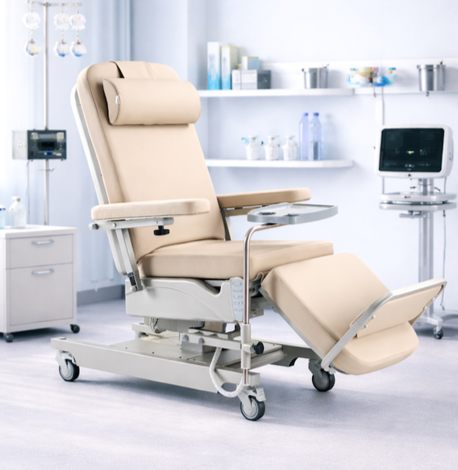
The question comes up early in every dialysis centre project, usually before the floor plan is finalised. Someone asks how many dialysis chairs the unit should hold, and the room goes quiet. Ten sounds reasonable. Fifteen sounds ambitious. Twenty sounds like a number that might sit half-empty for two years. Most planning teams end up guessing, then adjusting later at a cost they did not budget for.
There is a better way to arrive at the number, and it starts with arithmetic rather than instinct. The number of dialysis chairs a centre needs depends on three inputs: the expected patient load, the number of shifts you plan to run, and the time each session occupies the station. Get those three right and the answer usually falls out on its own.
Calculating Dialysis Chair Capacity from Patient Load
Start with weekly treatments rather than patient headcount.


Most maintenance haemodialysis patients receive three sessions a week. A centre serving 60 patients handles roughly 180 treatments across seven days. That is the number your chairs have to absorb.
Now divide by operating days. A centre running six days a week is handling 30 treatments a day. A centre running seven days handles about 26.
The daily treatment count is the number that matters. Patient headcount alone tells you very little about how busy the floor gets on a Tuesday morning.
See also: How to Choose Bedroom Furniture That Matches Your Lifestyle
Shift Planning and Station Turnover Time
Each station supports a limited number of sessions per day. That limit depends on the session length plus turnaround time.
A standard four-hour treatment does not occupy the station for four hours. Add setup, cannulation, post-session monitoring, chair cleaning and disinfection, and the realistic station cycle, and the total sits closer to five and a half hours.
Here is why that matters:
- A 12-hour operating day comfortably supports two shifts.
- A sixteen-hour day supports three shifts with tight turnaround discipline.
- An eighteen-hour day supports three shifts with breathing room.
Three shifts a day across 30 daily treatments gives you 10 stations. Two shifts give you 15.
The shift decision changes your chair count by 50 per cent. That is the single biggest lever in the whole calculation, and it gets decided far too casually in most projects.
Building in Spare Dialysis Chair Capacity
A centre running at 100 per cent station utilisation has no room to absorb anything.
Machines go for service. A patient needs an unscheduled session. Someone transfers in from another city. A chair develops a fault and waits on a spare part.
Plan for 10- 15% spare capacity. On a 10-station calculation, that means 11 or 12 chairs installed.
Some planners resist this because chairs cost money and empty stations look wasteful. The counter-argument is straightforward. A centre turning away transfer patients because every slot is committed loses revenue permanently, not temporarily.
Isolation Stations and Separate Chair Requirements
This part gets missed in early planning more often than it should.
Patients who are hepatitis B positive require dialysis in a separate area with dedicated machines. Many centres also isolate hepatitis C-positive patients as a matter of policy, though practices vary.
Your isolation stations do not draw from the general pool. They sit apart and often run below full utilisation because patient numbers are smaller.
Budget for them separately. A 12-station general floor plus 2 isolation stations is a 14-chair purchase, not a 12-chair purchase with two chairs moved across.
Specifying Dialysis Chairs for Multi-Shift Operation
Chair count is one decision. Chair specification is the one that determines whether your utilisation assumptions hold up.
A station running three shifts a day cycles through height adjustment, backrest positioning and leg rest movement perhaps 40 times daily. Over a year, a mechanical load most furniture never sees.
What to specify for high-turnover centres:
- Electronic adjustment for height, backrest, leg rest and footrest
- Disinfectant-resistant upholstery rated for repeated wipe-down between sessions
- Trendelenburg positioning
- Quick-release backrest mechanism
- Actuator cycle ratings stated in writing, with warranty terms to match.
Esthetica Medical Furniture builds its dialysis chairs around these requirements, with disinfectant-resistant surfaces and electronic positioning across the range. The cleaning specification matters more than people expect. Surfaces that degrade with repeated disinfection add minutes to every turnaround, and those minutes multiply quickly across three shifts.
Growth Planning and Phased Chair Purchases
Should you buy for day-one demand or for year-three demand?
Buying for day one keeps capital tied up in fewer units. It also means a second procurement cycle, a second delivery, and possible variation between chair batches if the manufacturer changes a model.
Buying for year three costs more upfront and leaves stations idle initially.
There is a middle path that works for most centres. Design the floor plan and the plumbing for the year-three station count. Purchase chairs in phases. The infrastructure cost is the part that becomes expensive to retrofit, not the furniture.
Most centres underestimate how quickly patient numbers build once referral relationships settle. Six months is usually the point where the picture becomes clear.
Next Steps
Run the arithmetic before you run the tender. Weekly treatments, divided by operating days, divided by realistic shifts per station, plus spare capacity, plus isolation stations.
Write the number down and test it against a scenario in which patient load grows by 30 per cent. If the plan holds, you have your count.